
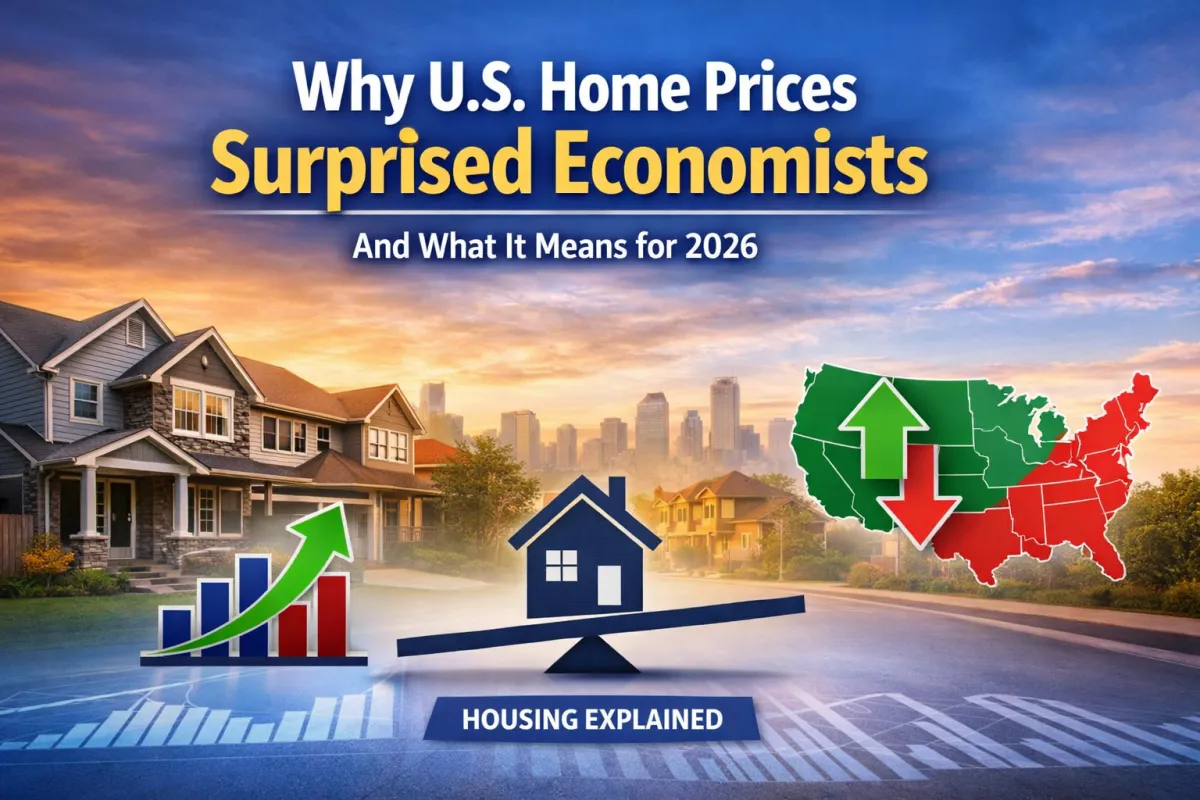
Why U.S. Home Prices Surprised Economists
At the end of 2025, most forecasts for the housing market were cautious.
Mortgage rates had remained elevated for much of the year. Affordability was stretched. Buyer activity had cooled from the pandemic frenzy. The prevailing expectation? Flat home prices — or even mild declines.
Instead, national home prices finished the year slightly stronger than expected.
According to the latest data, U.S. home prices rose modestly in 2025 — roughly 1% to 2% nationally, depending on the index. That’s a far cry from the double-digit gains of 2020–2022. But it’s also not a collapse.
And that’s what makes this moment interesting.
A Market That Refused to Break
The dominant narrative over the past two years has oscillated between two extremes:
“Prices are going to crash.”
“Housing is permanently unaffordable.”
What the data actually shows is something far less dramatic — and far more nuanced.
Home prices did not accelerate.
They did not implode.
They slowed.
This matters because housing is highly sensitive to financing conditions. With mortgage rates hovering in the mid-5% to 7% range over the past year, many economists expected demand to fall enough to pull prices lower.
But supply never surged.
Inventory remained constrained in much of the country, largely due to the “rate lock” effect — homeowners holding onto 2–3% mortgages and choosing not to sell. That limited supply helped stabilize prices even as buyer demand cooled.
In other words:
Higher rates reduced demand.
But limited inventory reduced supply.
And the two forces largely offset each other.
The Real Story: Divergence
The more important takeaway isn’t the modest national gain.
It’s the growing regional divergence.
Some Midwest and Northeast metros posted stronger price performance in 2025, benefiting from relative affordability and steadier local demand.
Meanwhile, certain Sunbelt markets — especially those that saw explosive pandemic-era growth — experienced price softness or outright declines.
This is what normalization looks like.
The pandemic housing boom pulled demand forward into fast-growing markets. As that surge unwinds, pricing pressure has eased in those areas first.
National averages smooth this out. Local markets reveal it.
And in 2026, local dynamics will matter more than national headlines.
Buyers Now Have More Leverage
Even with modest price growth, something important has shifted beneath the surface:
In many markets, sellers now outnumber buyers.
That’s a dramatic change from 2021 and 2022, when bidding wars were common and buyers waived contingencies just to compete.
Today, we’re seeing:
More price reductions
Longer days on market
Increased seller concessions
Greater inspection and financing negotiation power for buyers
This doesn’t mean prices are crashing.
It means balance is returning.
And balance tends to feel uncomfortable at first — especially after several years of extreme seller advantage.
Why Prices Didn’t Fall More
If affordability remains stretched, why didn’t prices drop further?
Three structural factors continue to support the market:
1. Constrained Supply
The U.S. still faces a long-term housing shortage, particularly in entry-level homes. New construction has improved but not enough to fully close the gap.
2. Locked-In Homeowners
Millions of homeowners refinanced below 4%. Selling means giving up historically low payments. That dramatically reduces move-up inventory.
3. Strong Labor Conditions
While economic uncertainty exists, widespread job losses have not materialized. Housing downturns tend to accelerate when unemployment spikes. That hasn’t happened.
Without a surge in forced selling, large national price declines become harder to sustain.
What This Means for 2026
So where does that leave us?
If mortgage rates stabilize in the mid-5% to low-6% range, we could see:
A modest rebound in buyer activity
Continued slow price appreciation nationally
Ongoing regional variation
More transaction volume without dramatic price swings
If rates rise meaningfully again, demand could soften further — but supply constraints would likely prevent a broad collapse.
If rates fall significantly, demand could accelerate faster than inventory builds, potentially reintroducing upward price pressure.
The most probable outcome?
A slow, uneven, locally driven housing cycle.
Not a boom.
Not a bust.
A recalibration.
The Bigger Picture
Housing doesn’t move in straight lines.
The pandemic created an extraordinary surge in both demand and price growth. The past two years have been about absorbing that shock.
Ending 2025 with modest national price gains tells us something important:
The market bent.
It didn’t break.
For buyers, that means more opportunity and negotiating power than in recent memory.
For sellers, it means pricing discipline matters more than ever.
For observers of the housing market, it means the story has shifted from extremes to equilibrium.
And equilibrium rarely makes headlines.
But it’s often where the real story begins.